Labuan, Malaysia
People’s Republic of China has grown to the position of the dominant producer and consumer of so-called rare earths, a group of 17 metallic elements in the periodic table made up of scandium, yttrium and the lanthanides. China’s position in production of other metals that are used in production of electronics, electric vehicles or battery packs is a bit less crucial. Besides China other Asian countries are also relevant in the field that predetermines long term economic performance, as Golden Brokers examined.
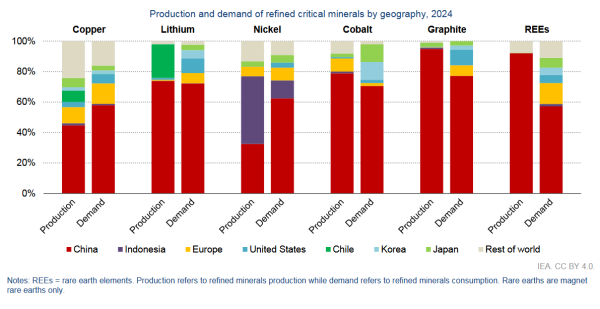
Sixty-one percent of mined rare earth global production comes from China, according to the International Energy Agency (IEA). The second most populous country controls 92% of the global output in the processing stage.
Rare earths include 17 metallic elements in the periodic table made up of scandium, yttrium and the lanthanides. The name “rare earths” is a bit of a misnomer, as the materials are found throughout the Earth’s crust. They are more abundant than gold, but they are difficult and costly to extract and process and are also environmentally damaging.
Rare earths are ubiquitous in everyday technologies, from smartphones to wind turbines to LED lights and flat-screen TVs. They’re crucial for batteries in electric vehicles, as well as MRI scanners and cancer treatments. Rare earths are also essential for military production, including F-35 fighters, submarines, lasers or satellites. Thus, they are some kind of strategic natural resources.
The position of China is not dominant only from the global point of view, but also within the Asian region. In fact, China is the only relevant producer of rare earths in Asia, according to IEA. China also produces around 50% more rare earths than it demands which makes China a net exporter of these natural resources. On the other hand, the greatest share on global demand for rare earths comes from Europe (around 15%). Japan’s share on global demand is under 10%, Korea and the United States have even lower demand, approximately 5% each. The rest of the world demands the rest production of rare earths.
But there are not only rare earths that can be marked for strategic metals. Besides rare earths there is also copper, lithium, nickel and cobalt. China dominates two of the mentioned four metals. China’s share on global cobalt production equals 80%, while its share on global demand slightly exceeds the 70% level. The second biggest Asian producer of cobalt can be seen in Japan with the global share between 3 and 4%. Around 1% of cobalt production is covered by Indonesia. China is also the biggest consumer of cobalt with approximately 70% share on global demand, followed by Korea (around 10%) and Japan (around 8%). This implies that China is a net exporter of cobalt while Japan, Korea and Indonesia are key net importers among the Asian nations.
The situation is very similar in the case of lithium. The only difference is that China’s share on global production is almost the same as its share on global demand (slightly above 70%). In other words, China is able to cover its consumption of lithium on its own, but almost no lithium is available for exports. The second largest producer of lithium is Chile (more than 20%), while the second global consumer of lithium is represented with United States (around 10%), Korea is number three (around 7%).
China has also the relative majority in global copper production – its share slightly exceeds the 40% level. The China’s demand for copper shares almost 60% on global demand, which makes China the net importer of copper. On the other hand, there is a net exporter of copper in the Asian region – Japan. Its share on global production is greater than its share on global demand (cca 6% vs cca 3%). Korea seems to be self-sufficient, similarly as Indonesia.
Completely different situation can be observed in the field of nickel. China’s share on global production is only around 35%, while its share on global demand exceeds 60%. The dominant country in nickel production is Indonesia with more than 40%. Indonesia’s share on global demand equals to around 15% so Indonesia is the net nickel exporter. Japan on the other hand is a net importer – its share on global demand represents around 4% while the production of nickel is very tiny in Japan with around 2% global share.
What to expect in the future? China will probably keep its dominant position in production and demand for critical minerals (metals) for some time. But as China will develop its electric vehicle industry, its electronics production and other key drivers of technological improvement, we could expect increasing scarcity of all the mentioned strategic metals. Not only in Asia but also in the entire world. This will result in increasing the relative prices of critical metals which will incentivize further technological improvement. In other words, we could expect a similar development as the world experienced in the field of fossil fuels (especially oil and natural gas).
This marketing material is provided for informational purposes only and should not be interpreted as investment advice, financial guidance, or a solicitation to engage in any investment activity. All information presented is general in nature and does not take into account your specific investment objectives, financial situation, or individual needs.
Golden Brokers Ltd. does not provide its services within the territory of the United Arab Emirates (UAE). Any references to products or services are not intended for residents or entities located in the UAE.


Discover more from Dubai Hospitality News
Subscribe to get the latest posts sent to your email.