Jeddah, Saudi Arabia, May 26, 2025
The second edition of the Islamic Arts Biennale, titled And All That Is In Between, closed its doors after a four-month run, from January 25 to May 25, 2025. Taking place at the Western Hajj Terminal of King Abdulaziz International Airport in Jeddah, the Biennale has strengthened its position as the world’s leading platform for Islamic arts.
During the closing symposium, His Excellency Rakan Altouq, Vice Chairman of the Diriyah Biennale Foundation and Assistant Minister of Culture, announced the launch of several initiatives that will continue the institutional partnerships and collaboration carried out in the AlMadar (“The Orbit”) section of the Islamic Arts Biennale. These initiatives include grants for joint research projects within the context of the Islamic Arts Biennale, the development of a digitization platform that will archive the objects exhibited, and the organisation of conferences in Saudi Arabia and at partner institutions worldwide to foster a growing network for deepening and sharing knowledge about Islamic arts.
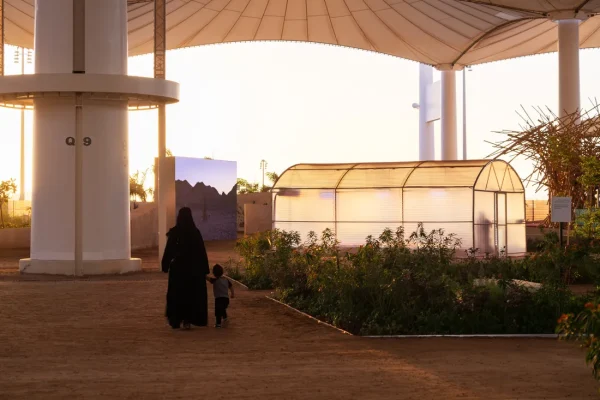
Building on the remarkable success of its inaugural edition, the 2025 Islamic Arts Biennale expanded significantly in scale, bringing together over 500 historical objects and contemporary works across five main exhibition halls and outdoor spaces totaling more than 100,000 square meters. With more than 30 international institutions participating from across 21 countries, and over 30 contemporary artists featured—including 29 new commissions—the Biennale offered visitors a unique journey through faith, time, and material culture.
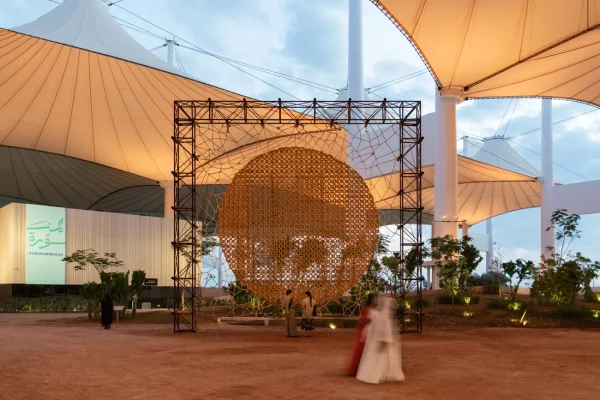
With the artistic direction of Julian Raby, Amin Jaffer, and Abdul Rahman Azzam, and with Saudi artist Muhannad Shono as Curator of Contemporary Art, And All That Is In Between presented the first-ever public display, outside Makkah, of the complete Kiswah—the cloth that covers the Holy Kaaba—alongside rare artifacts and sacred objects from Makkah and Madinah. The AlMusalla Prize–winning structure by EAST Architecture Studio for a prayer and gathering space, created using regionally sourced palm fiber and inspired by traditional weaving practices, became a centerpiece of the outdoor component of the exhibition. A part of the structure was installed in Venice at the exhibition Rooted Transience, a collateral event of the Venice Architecture Biennale, emphasizing the agile and mobile nature of this project.
The impact of the Biennale on the cultural life of Jeddah was in clear evidence, in the number of school visits, local businesses that were invited to activate shared spaces, especially during Ramadan, and participation from many private-sector partners. A robust calendar of public programs included the launch of the first edition of Turuq, which offered a setting to explore and celebrate food and histories of movement across cultures within and beyond the Arab world, and MADE., a forum that brought together designers from around the world in a dialogue between contemporary design and traditions found in Islamic arts. The education program welcomed over 23,110 students, while 15,021 participants took part in 446 public program events, including guided tours, talks, symposia, and community workshops.
Aya Al-Bakree, CEO of the Diriyah Biennale Foundation, commented: “The second edition of the Islamic Arts Biennale has surpassed expectations in its scale and impact. Through generous loans from institutions and the dedication of artists, curators, and artistic directors, who never flagged in their zeal for this remarkable project, the Biennale has illuminated the richness and diversity of Islamic artistic traditions. We are proud to have welcomed a broad and diverse audience, including local schoolchildren, international scholars, and many, many others.”
The Diriyah Biennale Foundation extends its gratitude to all participating artists, institutions, lenders, partners, and visitors who made And All That Is In Between an extraordinary success.
ABOUT THE ISLAMIC ARTS BIENNALE
The Diriyah Biennale Foundation’s Islamic Arts Biennale provides a holistic platform for new discourse about Islamic arts, offering an unparalleled space for learning, research, and insight. The exhibition takes place every two years at the Aga Khan Award–winning Western Hajj Terminal at King Abdulaziz International Airport in Jeddah, a city that for centuries has represented a junction point for cultural exchange and a venue that acts as a port of entry for millions of pilgrims on their journey to Makkah and Madinah. The first edition of the Biennale welcomed more than 600,000 visitors, and the second edition builds on this success in an expanded form. The Islamic Arts Biennale 2025 partners include Lead Partner Lexus and Principal Partners BSF, King Abdulaziz International Airport, Saudi Arabia Railways (SAR), and Saudia.
ABOUT THE DIRIYAH BIENNALE FOUNDATION
Inspired by the changes taking place in Saudi Arabia and the heritage site of Diriyah, and Chaired by H.H. Prince Badr bin Abdullah bin Farhan Al Saud, the Diriyah Biennale Foundation (DBF) assumes a critical role in nurturing creative expression and instilling an appreciation for culture and the arts and their transformative potential. The Foundation aspires to be a catalyst for lifelong learning and serves Saudi Arabia’s communities by offering opportunities to engage with the burgeoning local art scene. Central to the Foundation’s mandate is to stage two recurring world-class Biennales of contemporary and Islamic arts, year-round interactive educational programs, and overseeing the activation of JAX, a creative district with industrial heritage in Diriyah. At this historical moment of evolution and growth in Saudi Arabia, DBF’s Biennales showcase some of the world’s leading artists, drive cultural exchange between the Kingdom and international communities, promote dialogue and understanding, and further establish Saudi Arabia as an important cultural center.


Discover more from Dubai Hospitality News
Subscribe to get the latest posts sent to your email.